MPI Topology Communicators
We have already discussed setting up two-dimensional grids of processors. We set up our own mathematicsl to compute the topology, the layout of nearest neighbors as a funciton of row and column. But we could save ourselves the trouble, and possible errors, by using a built-in feature of MPI called Topology Communicators.
We have learned how to create new communicators. MPI provides a specialized set of routines to generate a communicator with the row and column coordinates computed for us. As usual, it also can provide the rank relative to the new communicator.
Communication at the ends of the Cartesian block can be periodic or nonperiodic. So far we’ve only considered nonperiodic boundaries, where for example the “left” of rank - is `MPI_PROC_NULL1, as is the “right” of the rank at the end of the row. We could also wrap the domain, so that data from rank 0 goes to rank nrows-1 and vice versa.
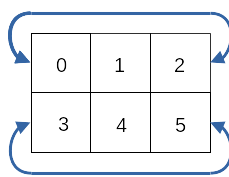
We will just summarize the types for the subprograms related to Cartesian communciator sytnax.
C++
int ndims;
dims is a 2-d int array with elements nrows, ncols
periods is a 2-d int array with elements 0 for nonperiodic boundary along the zeroth dimension (rows in our example) and 1 for a periodic boundary along the first dimension (columns in our example). A periodic boundary wraps the identity of the neighbor to the “empty” side of a rank.
reorder: allow (1) or not (0) MPI to reorder ranks if necessary. Often not needed for simple Cartesian grids.
grid_comm: MPI_Comm, the new communicator.
grid_coords: two-dimensional int array whose values are the coordinates of the location of the ranks specified relative to the Cartesian grid of the new communicator.
   MPI_Cart_create(MPI_COMM_WORLD, ndims, dims, periods, reorder, &grid_comm);
   MPI_Comm_rank(grid_comm, &grid_rank);
   MPI_Cart_coords(grid_comm, grid_rank, ndims, grid_coords);
   MPI_Cart_shift(grid_comm, direction, displ, &up, &down);
Fortran 2008
Other than periods and reorder, the types are similar to the C++ arguments. If using the optional last ierror argument, it is integer as usual.
periods: two-dimensional logical array with values .true. (periodic) or .false.(not periodic). reorder: logical .true. or .false.
  call MPI_Cart_create(MPI_COMM_WORLD, ndims, dims, periods,                 &
                                                     reorder, grid_comm)
   call MPI_Comm_rank(grid_comm, grid_rank)
   call MPI_Cart_coords(grid_comm, grid_rank, ndims, coords)
  call MPI_Cart_shift(grid_comm, direction, displ, up, down)
Python
dimes: two-dimensional list, arguments nrows, ncols as for other languages. periods: two-dimensional Boolean with arguments True (periodic) or False (nonperiodic) similar to Fortran. reorder: Boolean True or False.
grid_comm=comm.Create_cart(dims, periods)

grid_rank=grid_comm.Get_rank()
grid_coords=grid_comm.coords
(left,right)=grid_comm.Shift(direction,displ)
Example
C++
#include <cstring>
#include <iostream>
#include <iomanip>
#include <mpi.h>

using namespace std;

/*#This example exchanges data among four rectangular domains with halos.  Most real codes use squares, but we want to illustrate how to use different dimensions.  Divide up the processes.  Either we require a perfect square, or we must specify how to distribute by row/column.  In a realistic program,
the process distribution (either the total, for a perfect square, or
the rows/columns) would be read in and we would need to check that the number
of processes requested is consistent with the decomposition. */

int main (int argc, char *argv[]) {

    int N, M;

    // Added for MPI
    int nrl, ncl;
    int rank, grid_rank, nprocs;
    int up, down, right, left;
    int tag=0;

    //Initialize MPI
    MPI_Init(&argc, &argv);
    MPI_Comm_size(MPI_COMM_WORLD,&nprocs);
    MPI_Comm_rank(MPI_COMM_WORLD,&rank);

    N = 8;
    M = 12;

    int rows=2;
    int cols=3;

    if (rows*cols != nprocs) {
        cout<<"Number of rows times columns does not equal nprocs\n";
        return 1;
    }

    if (N%rows==0 && M%cols==0) {
        nrl = N/rows;
        ncl = M/cols;
    }
    else {
        cout<<"Number of ranks should divide the number of rows evenly.\n";
        return 2;
    }

    double **w=new double*[nrl+2];
    double *wptr=new double[(nrl+2)*(ncl+2)];

    for (int i=0;i<nrl+2;++i,wptr+=ncl+2) {
       w[i] = wptr;
    }

    double counter=1.;
    for ( int i = 0; i < nrl+2; i++ ) {
         for (int j = 0; j < ncl+2; j++ ) {
             w[i][j] = (rank+1)*counter;
             counter++;
         }
    }

    //Set up the topology assuming processes number left to right by row
    int ndims=2;
    int dims[2]={rows,cols};
    int periods[2]={1,0};
    int reorder=0;
    MPI_Comm grid_comm;
    int grid_coords[2];

    MPI_Cart_create(MPI_COMM_WORLD, ndims, dims, periods, reorder, &grid_comm);
    MPI_Comm_rank(grid_comm, &grid_rank);
    MPI_Cart_coords(grid_comm, grid_rank, ndims, grid_coords);

    int direction=0;
    int displ=1;
    MPI_Cart_shift(grid_comm, direction, displ, &up, &down);

    direction=1;
    MPI_Cart_shift(grid_comm, direction, displ, &left, &right);

    cout<<"topo "<<grid_rank<<" "<<up<<" "<<down<<" "<<left<<" "<<right<<endl;

    //Boundary conditions
    double topBC=0.;
    double bottomBC=200.;
    double rightBC=100.;
    double leftBC=100.;

    if (grid_coords[0]==0) {
       for (int i=0;i<=ncl+1;++i){
          w[0][i]=topBC;
       }
    }
    if (grid_coords[0]==rows-1) {
        for (int i=0;i<=ncl+1;++i){
            w[nrl+1][i]=bottomBC;
       }
    }

    if (grid_coords[1]==0) {
        for (int i=0;i<=nrl+1;++i){
            w[i][0]=leftBC;
        }
    }
    if (grid_coords[1]==cols-1) {
        for (int i=0;i<=nrl+1;++i){
            w[i][ncl+1]=rightBC;
        }
    }

    //Set up the MPI type for columns
    MPI_Datatype col;
    MPI_Type_vector(nrl,1,ncl+2,MPI_DOUBLE,&col);
    MPI_Type_commit(&col);

    MPI_Status status;

    MPI_Sendrecv(&w[1][0],ncl+2, MPI_DOUBLE,up,tag,&w[nrl+1][0],
                          ncl+2, MPI_DOUBLE,down,tag,grid_comm,&status);

    MPI_Sendrecv(&w[nrl][0],ncl+2,MPI_DOUBLE,down,tag,&w[0][0],
                            ncl+2,MPI_DOUBLE,up,tag,grid_comm,&status);

    MPI_Sendrecv(&w[1][ncl],1,col,right,tag,&w[1][0],1,col,left,                                             tag, grid_comm, &status);
    MPI_Sendrecv(&w[1][1],1,col,left,tag,&w[1][ncl+1],1,col,right,                                           tag, grid_comm, &status);


    //Verification. Usually done with plots in real codes.
    //Simplified from earlier examples, we'll just spot-check
    //Same original values
    //
    int nrl_total=nrl+2;
    int ncl_total=ncl+2;
    double *u=new double[(nrl_total)*(ncl_total)];
    int uwsize=(nrl_total)*(ncl_total);
    memset(u,0.,uwsize);
    int position;

    MPI_Barrier(grid_comm);
    if ( grid_rank == 0 ) {
        MPI_Recv(u,uwsize,MPI_DOUBLE,1,1,grid_comm,&status);
        cout<<"Ranks 0 and 1  Check columns"<<endl;
        position=0;
        for (int i=0;i<nrl_total;i++) {
            for (int j=0;j<ncl_total;j++) {
                cout<<w[i][j]<<" ";
            }
            cout<<" | ";
            for (int j=0;j<ncl_total;j++) {
                cout<<u[position++]<<" ";
            }
            cout<<endl;
        }
        cout<<endl;
    }

    if ( grid_rank == 1 ) {
        position=0;
        for (int i=0; i<nrl_total; i++)
            for (int j=0;j<ncl_total; j++)
                u[position++]=w[i][j];

        MPI_Send(u,uwsize,MPI_DOUBLE,0,1,grid_comm);

    }
    MPI_Barrier(grid_comm);

    //Check columns on other side
    //
    memset(u,0.,uwsize);
    if ( grid_rank == 1 ) {
        MPI_Recv(u,uwsize,MPI_DOUBLE,2,2,grid_comm,&status);
        cout<<"Ranks 1 and 2 Check columns"<<endl;
        position=0;
        for (int i=0;i<nrl_total;i++) {
            for (int j=0;j<ncl_total;j++) {
                cout<<w[i][j]<<" ";
            }
            cout<<" | ";
            for (int j=0;j<ncl_total;j++) {
                cout<<u[position++]<<" ";
            }
            cout<<endl;
        }
        cout<<endl;
    }

    if ( grid_rank == 2 ) {
        position=0;
        for (int i=0; i<nrl_total; i++)
            for (int j=0;j<ncl_total; j++)
                u[position++]=w[i][j];

        MPI_Send(u,uwsize,MPI_DOUBLE,1,2,grid_comm);

    }
    MPI_Barrier(grid_comm);

    //Check periodic row exchanges
    //
    memset(u,0.,uwsize);
    if ( grid_rank == 0 ) {
        MPI_Recv(u,uwsize,MPI_DOUBLE,3,3,grid_comm,&status);
        cout<<"Ranks 0 and 3  Check rows including periodic exchange"<<endl;
        for (int i=0;i<nrl_total;i++) {
            for (int j=0;j<ncl_total;j++) {
                cout<<w[i][j]<<" ";
            }
            cout<<endl;
        }

        cout<<"-=---------------------------------------------------"<<endl;

        position=0;
        for (int i=0;i<nrl_total;i++) {
            for (int j=0;j<ncl_total;j++) {
                cout<<u[position++]<<" ";
            }
            cout<<endl;
        }
        cout<<endl;
    }

    if ( grid_rank == 3 ) {
        position=0;
        for (int i=0; i<nrl_total; i++)
            for (int j=0;j<ncl_total; j++)
                u[position++]=w[i][j];

        MPI_Send(u,uwsize,MPI_DOUBLE,0,3,grid_comm);

    }
    MPI_Barrier(grid_comm);
    //end checking section

    //Type_free not really necessary but good practice
    MPI_Type_free(&col);

    MPI_Comm_free(&grid_comm);

    MPI_Finalize();

    return 0;

}
Fortran
program cart_topo
   use mpi_f08
   implicit none

   double precision, allocatable, dimension(:,:)  :: w
   double precision, allocatable, dimension(:,:)  :: u
   integer            :: N, M
   integer            :: i,j

   integer            :: nrows, ncols, nrl, ncl
   integer            :: rank, nprocs, tag=0
   integer, dimension(2) :: dims, coords
   logical, dimension(2) :: periods
   logical            :: reorder
   integer            :: ndims, grid_rank
   integer            :: direction, displ
   type(MPI_Comm)     :: grid_comm
   type(MPI_Status)   :: mpi_stat
   type(MPI_Datatype) :: row

   integer            :: left, right, up, down
   integer            :: uwsize
   double precision   :: topBC, bottomBC, edgeBC

   !Initialize MPI, get the local number of columns
   call MPI_INIT()
   call MPI_COMM_SIZE(MPI_COMM_WORLD,nprocs)
   call MPI_COMM_RANK(MPI_COMM_WORLD,rank)

   N=8
   M=12

   nrows=2
   ncols=3

   if (nrows*ncols /= nprocs) then
       call MPI_Finalize()
       stop "Number of rows times columns does not equal nprocs"
   endif

   if (mod(N,nrows)==0 .and. mod(M,ncols)==0) then
       nrl = N/nrows
       ncl = M/ncols
   else
       call MPI_Finalize()
       stop "Number of ranks should divide the number of rows evenly."
   endif

   !**create cartesian topology for processes
   ndims=2
   dims(1) = nrows      ! number of rows
   dims(2) = ncols      ! number of columns
   periods(1) = .true.  ! cyclic in this direction
   periods(2) = .false. ! not cyclic in this direction
   reorder    = .false.  ! allow MPI to reorder if it sees fit
   call MPI_Cart_create(MPI_COMM_WORLD, ndims, dims, periods,                 &
                                                     reorder, grid_comm)
   call MPI_Comm_rank(grid_comm, grid_rank)
   call MPI_Cart_coords(grid_comm, grid_rank, ndims, coords)

   direction =  0   ! shift along the 1st index (0 or 1)
   displ =  1       ! shift by  1
   call MPI_Cart_shift(grid_comm, direction, displ, up, down)

   direction =  1   ! shift along the 2nd index (0 or 1)
   displ =  1       ! shift by  1
   call MPI_Cart_shift(grid_comm, direction, displ, left, right)

   !write(*,*) 'topo', grid_rank, up, down, left, right

   ! Set up values
   allocate(w(0:nrl+1, 0:ncl+1))
   w=reshape([(i,i=1,(nrl+2)*(ncl+2))],(/nrl+2,ncl+2/))
   w=(grid_rank+1)*w

   ! Boundary conditions
   topBC=0.d0
   bottomBC=200.d0
   edgeBC=300.d0
   if (coords(1)==0) then
      w(0,:)=topBC
   else if (coords(1)==nrows-1) then
      w(nrl+1,:)=bottomBC
   endif
   if (coords(2)==0) then
       w(:,0)=edgeBC
   else if (coords(2)==ncols-1) then
      w(:,ncl+1)=edgeBC
   endif

   call MPI_Type_vector(ncl+2,1,nrl+2,MPI_DOUBLE_PRECISION,row)
   call MPI_Type_commit(row)

  ! Exchange halo values

  ! Send left and right

   call MPI_SENDRECV(w(1:nrl,1)    ,nrl,MPI_DOUBLE_PRECISION,left,tag,       &
                     w(1:nrl,ncl+1),nrl,MPI_DOUBLE_PRECISION,right,tag,      &
                                                    grid_comm,mpi_stat)
   call MPI_SENDRECV(w(1:nrl,ncl)  ,nrl,MPI_DOUBLE_PRECISION,right,tag,      &
                     w(1:nrl,0)    ,nrl,MPI_DOUBLE_PRECISION,left,tag,       &
                                                    grid_comm,mpi_stat)

  ! Send up and down

   call MPI_SENDRECV(w(1,0)  ,1, row, up,tag, w(nrl+1,0),1, row,down,tag,    &
                                                        grid_comm,mpi_stat)
   call MPI_SENDRECV(w(nrl,0) ,1, row, down,tag, w(0,0)   ,1,row, up,tag,    &
                                                        grid_comm,mpi_stat)


! Check results
   allocate(u(0:nrl+1,0:ncl+1))
   uwsize=(nrl+2)*(ncl+2)
   !Check columns
   u=0.d0
   if (grid_rank==0) then
       call MPI_Recv(u,uwsize,MPI_DOUBLE_PRECISION,1,1,grid_comm,mpi_stat)
       write(*,*) "Ranks 0 and 1 check columns "

       do i=0,nrl+1
             write(*,'(*(f8.1))',advance='no') w(i,:)
             write(*,'(a)',advance='no') "|"
             write(*,'(*(f8.1))') u(i,:)
       enddo
       write(*,*)
   endif
   if (grid_rank==1) then
       call MPI_Send(w,uwsize,MPI_DOUBLE_PRECISION,0,1,grid_comm)
   endif

   call MPI_Barrier(grid_comm)

   u=0.d0
   if (grid_rank==1) then
       call MPI_Recv(u,uwsize,MPI_DOUBLE_PRECISION,2,2,grid_comm,mpi_stat)
       write(*,*) "Ranks 1 and 2 check columns "

       do i=0,nrl+1
             write(*,'(*(f8.1))',advance='no') w(i,:)
             write(*,'(a)',advance='no') "|"
             write(*,'(*(f8.1))') u(i,:)
       enddo
       write(*,*)
   endif

   if (grid_rank==2) then
       call MPI_Send(w,uwsize,MPI_DOUBLE_PRECISION,1,2,grid_comm)
   endif


   call MPI_Barrier(grid_comm)

   ! Check rows including periodic exchange
   u=0.d0
   if (grid_rank==0) then
       call MPI_Recv(u,uwsize,MPI_DOUBLE_PRECISION,3,3,grid_comm,mpi_stat)
       write(*,*) "Ranks 0 and 3 check rows including periodic exchange "

       do i=0,nrl+1
             write(*,'(*(f8.1))') w(i,:)
       enddo

       write(*,*) "--------------------------------------------------"

       do i=0,nrl+1
             write(*,'(*(f8.1))') u(i,:)
       enddo

   endif
   if (grid_rank==3) then
       call MPI_Send(w,uwsize,MPI_DOUBLE_PRECISION,0,3,grid_comm)
   endif

   call MPI_Barrier(grid_comm)

   call MPI_Type_free(row)
   call MPI_Comm_free(grid_comm)

   call MPI_Finalize()

end program
Python
import sys
import numpy as np
from mpi4py import MPI

comm = MPI.COMM_WORLD
rank = comm.Get_rank()
nprocs = comm.Get_size()

#This example exchanges data among four rectangular domains with halos.
#Most real codes use squares, but we want to illustrate how to use different
#dimensions.

#Divide up the processes.  Either we require a perfect square, or we
#must specify how to distribute by row/column.  In a realistic program,
#the process distribution (either the total, for a perfect square, or
#the rows/columns) would be read in and we would need to check that the number
#of processes requested is consistent with the decomposition.

N = 8
M = 12

nrows=2
ncols=3

if nrows*ncols != nprocs:
    print("Number of rows times columns does not equal nprocs")
    sys.exit()

if N%nrows==0 and M%ncols==0:
    nrl = N//nrows
    ncl = M//ncols
else:
    print("Number of ranks should divide the number of rows evenly.")
    sys.exit()

#Set up the topology
ndims=2
dims=[nrows, ncols]
periods=[True, False]
grid_comm=comm.Create_cart(dims, periods)

grid_rank=grid_comm.Get_rank()
grid_coords=grid_comm.coords

direction=0
displ=1
(up,down)=grid_comm.Shift(direction, displ)
direction=1
(left,right)=grid_comm.Shift(direction,displ)

#print("Topo {:d} {:} {:d} {:d} {:d}".format(grid_rank,left,right,up,down))

w = np.zeros((nrl+2, ncl+2), dtype=np.double)

#Arbitrary values.
w[:,:] = np.reshape(np.arange(1,(nrl+2)*(ncl+2)+1),(nrl+2,ncl+2))
w=w*(grid_rank+1)

#Bouncary conditions
topBC=0.
bottomBC=200.
edgeBC=100.
if grid_coords[0]==0:
    w[0,:]=topBC
if grid_coords[0]==nrows-1:
    w[nrl+1,:]=bottomBC
if grid_coords[1]==0:
    w[:,0]=edgeBC
if grid_coords[1]==ncols-1:
    w[:,ncl+1]=edgeBC

# set up MPI types for columns
column_zero=MPI.DOUBLE.Create_subarray([nrl+2,ncl+2],[nrl,1],[1,0])
column_zero.Commit()

column_one=MPI.DOUBLE.Create_subarray([nrl+2,ncl+2],[nrl,1],[1,1])
column_one.Commit()

column_end=MPI.DOUBLE.Create_subarray([nrl+2,ncl+2],[nrl,1],[1,ncl])
column_end.Commit()

column_endbc=MPI.DOUBLE.Create_subarray([nrl+2,ncl+2],[nrl,1],[1,ncl+1])
column_endbc.Commit()

tag=0

# sending up and receiving down
grid_comm.Sendrecv([w[1,0:ncl+2],MPI.DOUBLE], up, tag, [w[nrl+1,0:ncl+2],MPI.DOUBLE], down, tag)
# sending down and receiving up
grid_comm.Sendrecv([w[nrl,0:ncl+2],MPI.DOUBLE], down, tag, [w[0,0:ncl+2],MPI.DOUBLE], up, tag)

# sending left and right
grid_comm.Sendrecv([w,1,column_one], left, tag, [w,1,column_endbc], right, tag)
grid_comm.Sendrecv([w,1,column_end], right, tag, [w,1,column_zero], left, tag)

#Results
status=MPI.Status()
#Check row exchange
u=np.zeros_like(w)
uwsize=(nrl+2)*(ncl+2)

grid_comm.Barrier()
if grid_rank==0:
    grid_comm.Recv([u,MPI.DOUBLE],source=1,tag=1,status=status)
    print("Ranks 0 and 1 check columns")

    for i in range(nrl+2):
        print(w[i,:],end='')
        print("  |  ",end='')
        print(u[i,:])

    print()

if grid_rank==1:
    grid_comm.Send([w,MPI.DOUBLE],dest=0,tag=1)

grid_comm.Barrier()
u[:,:]=0.0
if grid_rank==1:
    grid_comm.Recv([u,MPI.DOUBLE],source=2,tag=2,status=status)
    print("Ranks 1 and 2 check columns")

    for i in range(nrl+2):
        print(w[i,:],end='')
        print("  |  ",end='')
        print(u[i,:])

    print()

if grid_rank==2:
    grid_comm.Send([w,MPI.DOUBLE],dest=1,tag=2)

#Checkrows including periodic
grid_comm.Barrier()
u[:,:]=0.0
if grid_rank==0:
    grid_comm.Recv([u,MPI.DOUBLE],source=3,tag=3,status=status)
    print("Ranks 0 and 3 check rows including periodic exchange")

    for i in range(nrl+2):
        print(w[i,:])

    print('-----------------------------------------')

    for i in range(nrl+2):
        print(u[i,:])

if rank==3:
    grid_comm.Send([w,MPI.DOUBLE],dest=0,tag=3)