Shared Memory Programming
Our focus so far has been on distributed memory parallel programming. Each process run separately and accesses its own block of memory. As far as the system is concerned, they are different copies of the same program running, similar to how a user might run multiple copies of a Python interpreter with different files. MPI provides a library that enables these processes to maintain contact and exchange information. Distributed parallel programs can also run on multiple nodes.
The other main parallel programming model is shared_memory programming. This type of parallel program runs on a multiprocessor, a computer with multiple processing units that share the main memory of the system. These processing units can be utilized together in a threaded programming model.
In computer engineering, a thread is a unit of process control. It maintains its own set of registers, program counters, and a portion of main memory (a stack). Threads can be “heavyweight” or “lightweight.” A heavyweight thread corresponds closely to what we have been calling a “process.” Lightweight threads are subprocesses that usually are managed by a heavyweight thread.
Threads can be created at the “kernel” (the core of the operating system) level or the user level. Kernel threads run in the background and enable the kernel to simultaneously manage multiple resources and tasks. User threads are created when requested and are managed by a threading library.
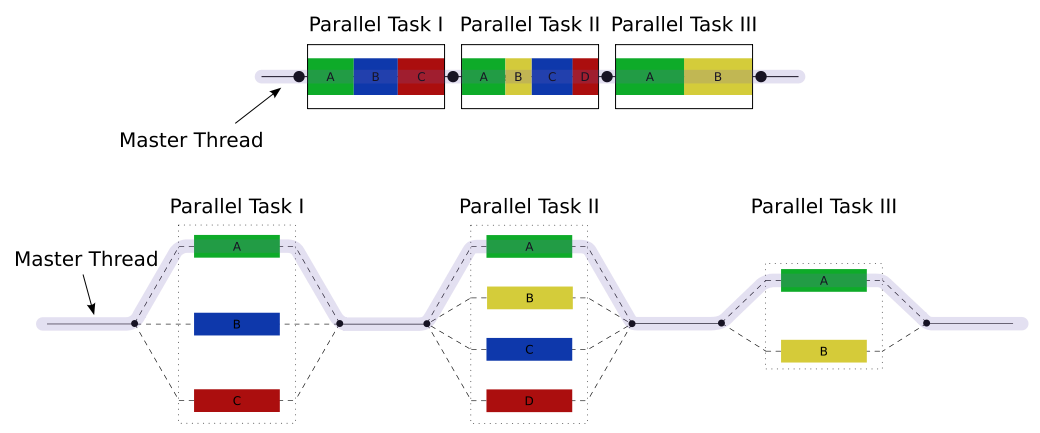
In the context of shared-memory programming, a thread is a subprocesses that is forked by the root process and joined when is no longer needed. Threaded programs must run on a single node, and the number of processes is limited by the number of processing units on the node. The fork can occur when the executable is initiated, with the join happening as it exists, or threads can be forked and joined at different points within the run.
Some modern architectures incorporate hyperthreading, where a single core can execute multiple threads in parallel, rather than by switching between them. This can be suitable for some user-level multithreading, but not all CPUs support this and it is usually best to run one thread per core in shared-memory programming.